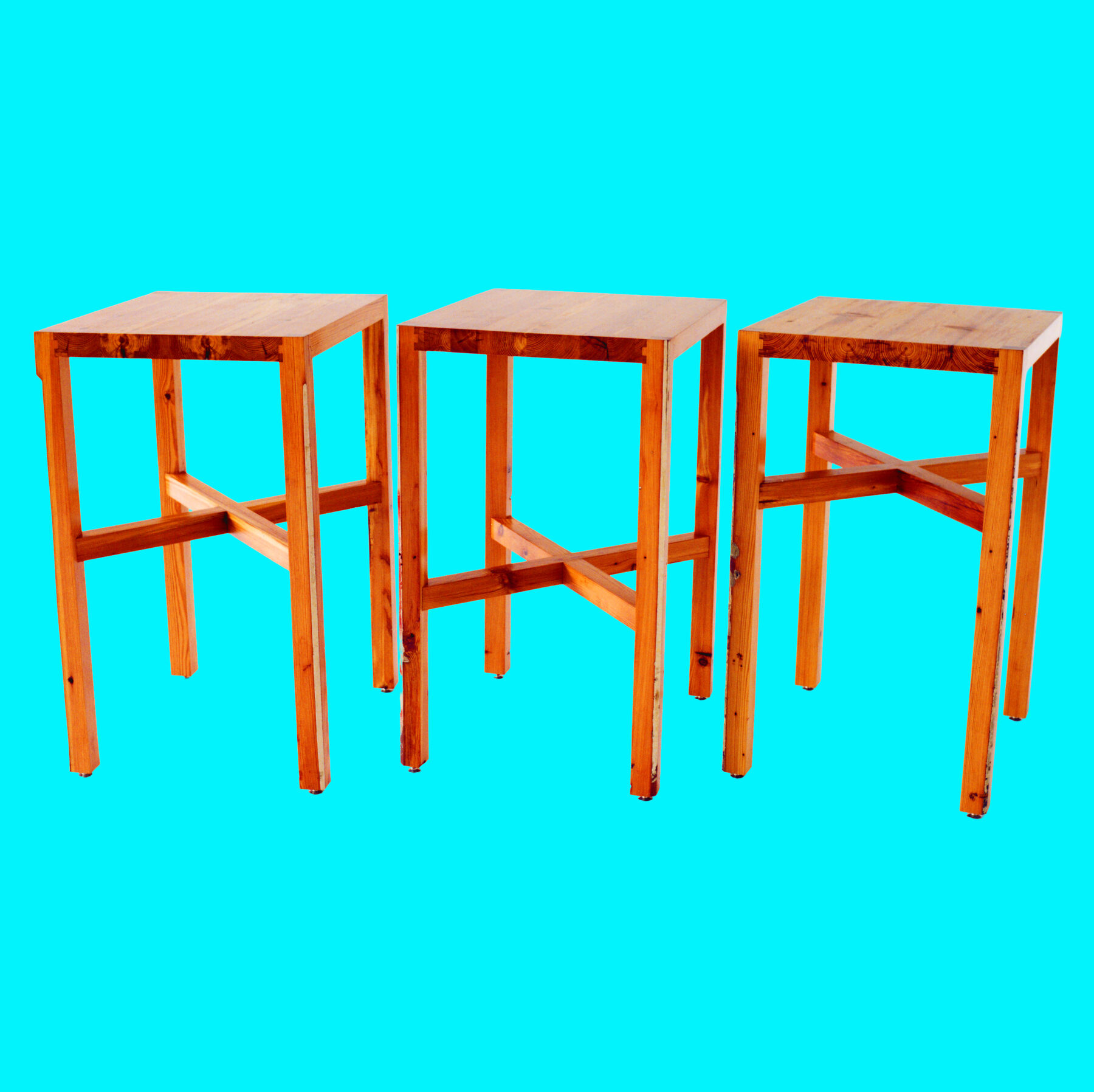
Three tall café tables made for the Space Photo Studio, on the top floor of the Chelsea Market building — formerly the original Nabisco factory, where the first Oreo was made. The beams the wood came from had held up that floor's ceiling until they were replaced with rooftop I-beams to open up the space for photography. Andrew first saw the wood on a tour with studio owner Paul Brown, who'd already paid someone else to build crude café tables from the raw beams; Andrew told him he'd make real ones instead.
The legs use mortise-and-tenon joinery, braced between each other with a half-lap stretcher — but where each leg meets the tabletop is a different joint entirely, and it's what makes this a Parsons-style table, a term Andrew didn't actually know until he later went on to work at Parsons School of Design. Each corner of the tabletop is cut away, leaving a square notch, and the leg is rabbeted to fill it, so the leg reads flush with the surface on top as well as down the sides, rather than hiding under an apron. A tenon wraps around the leg and locks into a matching mortise that wraps around the cut-out corner, centered on the thickness of the top, holding the joint tight from the side. No screws or fasteners anywhere in it.
His shop-mate Jaren taught him to finish the sap-filled old-growth pine with a hand plane and card scraper rather than sanding, cutting the grain cleanly so the amber, sap-streaked wood shines. It's the same finishing method Andrew has used on many pieces since, and this is likely the earliest-dated piece in his whole catalog — the origin point for the wood later reused, in this order, in the Mini Belly Dining Table, The Wing Table, the Triple Belly Table, and, decades later, the Pincushion Cactus Chair, which uses its own, different joinery.