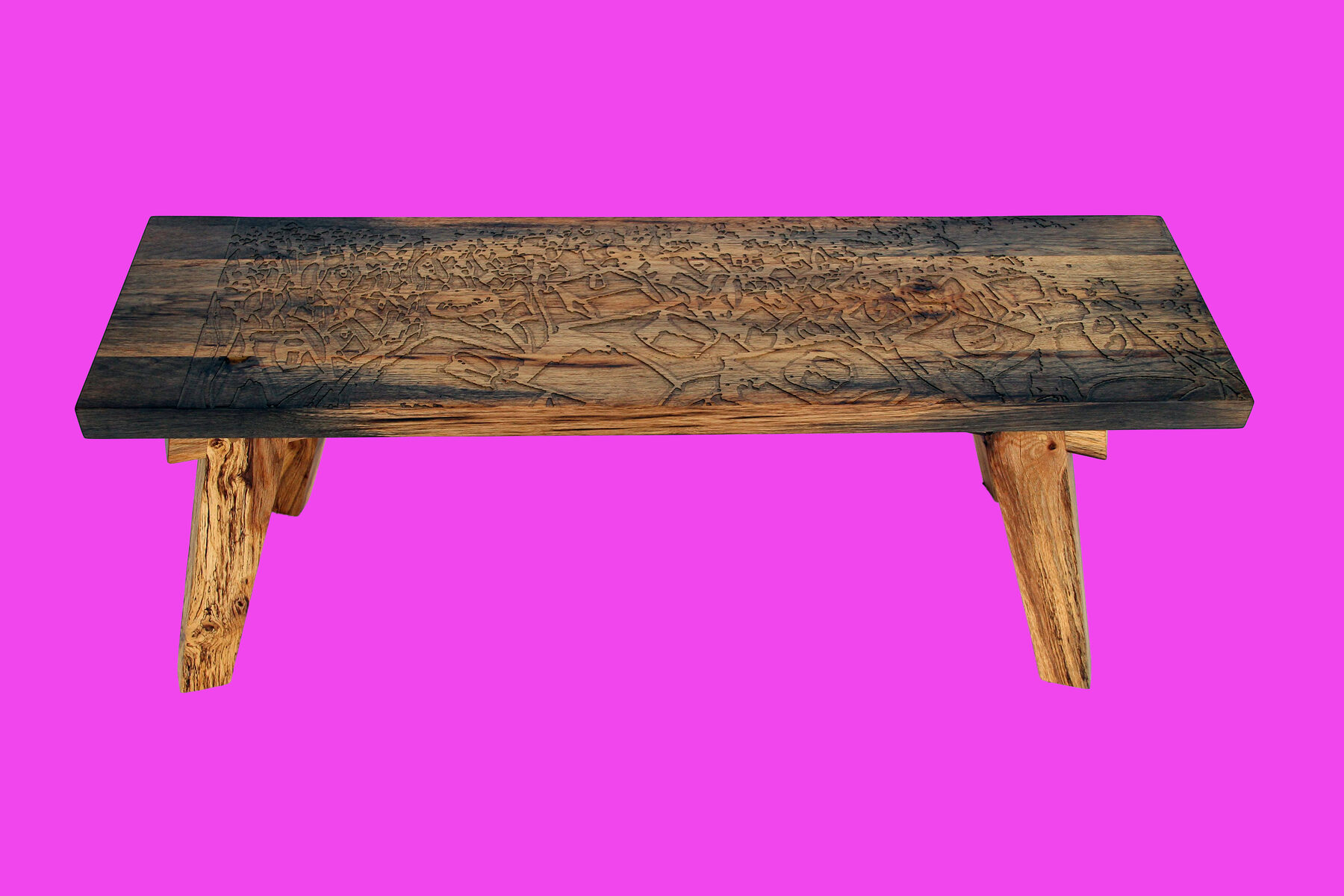
The Marshmallow Box Bench is a bench, not a box — a thick, rich, dark persimmon slab top on canted oak legs marbled with beautiful dark layers of spalting. It isn't shaped like a marshmallow or a box. The name comes from what's carved into the top.
The top is carved as a print block, bearing an image of the fabled, rarely sighted Marshmallow Box Garden. As legend has it, while hiking in the Rocky Mountains, Andrew came across a beautiful marshmallow box garden and was able to capture the image in a plein air drawing before carving it into the bench's top. He also procured seeds from the garden, which he later used to recreate it in Los Angeles and Boston — the fictional origin story behind the real Marshmallow Box Garden installations at Anderson Ranch, Craft Contemporary, and the Eliot School. It's a deliberately invented origin for the marshmallow box, standing in open contradiction to the object's real one: a whole mythology, built out of the idea of little boxes growing on stems, marshmallows inside.
Once the top was carved, Andrew worked with fellow artist-in-residence Stephany Dykes to pull hand-rubbed prints directly from the bench's own seat. Once the prints dried, they were wetted again and pressed back onto the bench for embossing — but the top was too thick to fit through an actual printing press, so they tried a woodworking vacuum press instead. To Stephany's surprise, it worked, and the technique has since become one Andrew has used across several other print series, including the Cloud Cathedral Prints.
The idea started with seeing a lithography stone and wondering why a piece of furniture couldn't double as a printing surface the same way a master printer's stone does — paired with wanting art and furniture to share the same room, a print from a piece hanging on the wall above the piece itself. This was the first time Andrew built that idea into a piece; he returned to it again later for the Tablet Table.