The idea started at a bonfire, not a workbench. Andrew was at a party where everyone was making s'mores, and a friend visiting from another country said she'd never seen a marshmallow before. He couldn't get over it — in the U.S. the marshmallow is practically a rite of passage, the centerpiece of one of the first things a kid ever gets to make on their own terms. Everyone's s'more is a little different: some people like theirs barely warmed, some torch it black and peel off the charred skin to get at the molten inside, but the ritual of heating a marshmallow on a stick and pressing it between graham crackers and chocolate is close to universal for anyone who ever sat around a fire as a kid. (The running joke Andrew tells about it: the very adults who first hand a kid a marshmallow on a stick are often, by then, the ones who can no longer eat one themselves — a lifetime of marshmallows having worn straight through their enamel.) That a whole life could pass without ever encountering it struck him as strange, and a little sad.
Looking at the marshmallow itself with fresh eyes, Andrew found the object genuinely bizarre — a squishy, gooey, spongy confection unlike almost anything else people eat — and decided to give it its own small monument: a box. Not just any box. Both the lid and the base are mortised with a matching cylindrical cavity, sized so a single marshmallow sinks two-thirds of the way into the base and one-third into the lid. Lift the lid off and only that top third is left exposed, sitting flush in the base like a small white button.
That detail was the whole point when the box debuted at Dwell on Design in 2009, handed out with no explanation at all. People would see the lid come off, see the pale round shape sitting there, and — almost without exception — poke it. Their finger would sink into the soft sugar puff exactly like poking the Pillsbury Doughboy's belly, and they'd get that same startled, delighted laugh before realizing what they were holding. Then came the real payoff: nearly everyone who figured out it was a marshmallow wanted to tell Andrew a story — almost always some warm, specific memory from their own childhood. Getting to collect those stories, one stranger at a time, is what turned a strange little object into something Andrew got genuinely obsessed with.
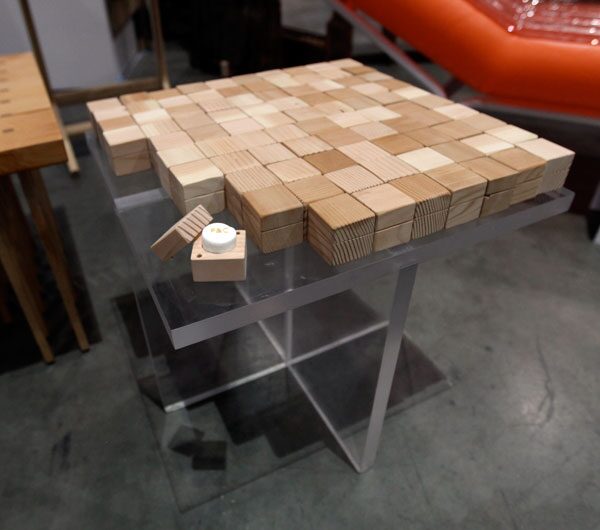
The boxes themselves were carried to that 2009 debut on The Slip Table, a low, flat-packing display stand Andrew built just to hold them at Ford & Ching's booth at Dwell on Design. Later that year, a second run of 108 went out from Ford & Ching's Satellite Showroom in Oakland — each box individually numbered and branded into the wood by hand, a different small drawing burned into each lid: a blimp, a flower, whatever came to mind that day. In 2012, the boxes turned up again at Jai & Jai gallery in Los Angeles, as part of the group show Wrong Side Up — one of them rigged so an actual marshmallow sat hidden inside its carved compartment, the joke made literal, there only for whoever opened it.
Looking back, Andrew thinks that reaction is really the whole function of the piece. The box disguises the marshmallow just enough that a viewer doesn't immediately recognize something completely familiar to them — and that flicker of not-recognizing, then recognizing, is what does the work. It hands most adults a second chance to see a marshmallow the way they first did as a kid at a campfire, making s'mores. The object itself is unassuming enough to be easy to forget, but like a favorite stone picked up on a walk, just holding it again brings the memories flooding back. It's a time warp disguised as a wooden box — simple, quiet, and completely unimposing on the outside, but capable of dropping a grown adult straight back into childhood in about one second. In all the stories people have told him over the years, Andrew has never once heard a sad one — as far as he can tell, there's no such thing as a sad marshmallow story.
He also hadn't fully planned on the box reading as a ring box — small, hinged-feeling, lined, made to be opened by someone else. A few people asked for one specifically to hide a ring inside for a proposal. The best version of that happened at the opening for the Anderson Ranch installation, when a woman got down on one knee, held up a box with a marshmallow sitting inside it, and asked him: "Will you marshmallow me?"
The Anderson Ranch residency itself marked a real shift for Andrew — the moment he was brought in as an artist in residence rather than a fabricator or woodworker, an important turn in how his work was seen. He spent that fall sanding and finishing boxes outdoors in the Colorado Rockies, aspen groves turning gold and starting to drop before winter, a long way from his usual studio near Skid Row in downtown LA. It felt almost like an indulgence at first — sanding tiny boxes in the mountains instead of building "epic" furniture — and he had to work through some guilt about it before realizing the two weren't actually different in kind: quieter and smaller, but just as much the work.
Andrew's one regret is not recording the stories people told him at Dwell on Design in real time — a decade-plus of them now exist only in memory. This site is his way of trying to get at least some of that back into the world before it's gone for good: a small, ridiculous, joyful idea, repeated by hand for over a decade, that turned out to carry more meaning than he expected when he first cut that little cylinder into a block of wood. It's also the building block for everything else in the project — grouped into the Bench, pulled into ink for the Prints, and planted by the hundreds across three Garden installations.