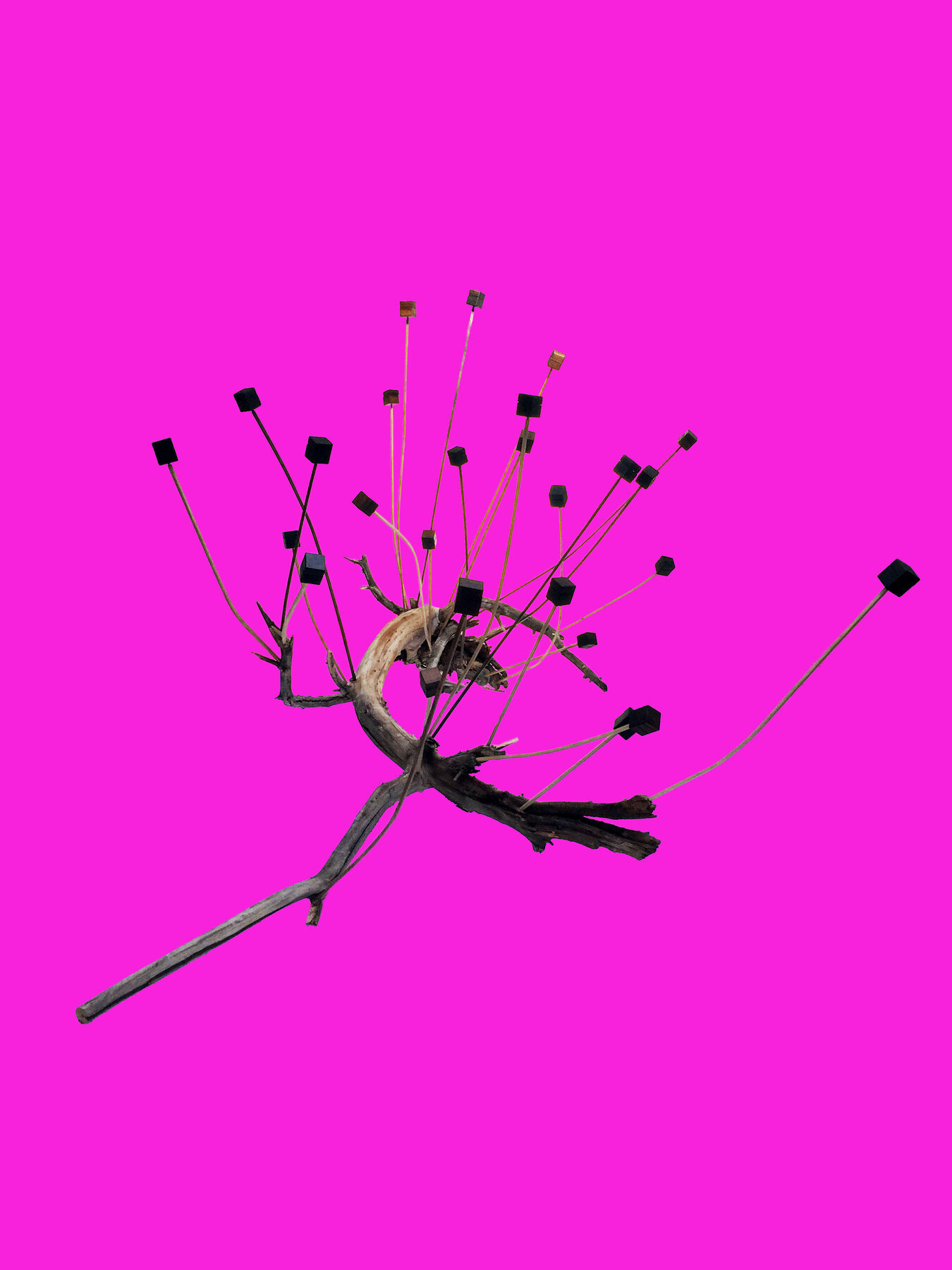
Square stems bend and twist as they grow toward the sky, each one topped with a single square box. Inside sits a single puffy, ripe marshmallow, ready to eat. Hundreds of these little wooden boxes are sprouting up and growing wild, full of plump confectionary treats, right here in Los Angeles, California. Rare spores discovered deep in the Rocky Mountains were planted in a fallen aspen tree, as well as a branch from a mesquite tree from Borrego Springs, California — and, miraculously, they grew.
Seen together in the gallery, their square stems bending and twisting, the marshmallows bursting the tops off their boxes, poking out — it's like walking through an orchard in fall.
Shown as part of Windfall at Craft Contemporary in Los Angeles, this installation scaled the Marshmallow Box Garden up to gallery size — hundreds of individually sanded and finished boxes, each grain-matched from top to bottom, arranged across the floor as a single field rather than a scattering of individual objects. Seen together, the boxes read the way a stand of trees reads: countless individual units resolving, from a distance, into one continuous form.
The installation represents years of accumulated labor from students and volunteers who sanded and finished nearly a thousand of the boxes by hand — work that's easy to miss in a photograph of the finished field but is, in Andrew's words, most of what the piece actually is. It's also the clearest statement of the project's core logic: that repeating one small, almost absurd idea enough times is what finally makes it real.
Craft Contemporary (then the Craft & Folk Art Museum) gave the piece its front window and lobby — a rare, high-visibility placement for an installation, and one of the bigger honors of the show. One studio shot from that run sends the boxes up off the floor entirely: the mesquite branch from Borrego Springs strung with boxes on wire, part of the same installation staged for the museum's window.